
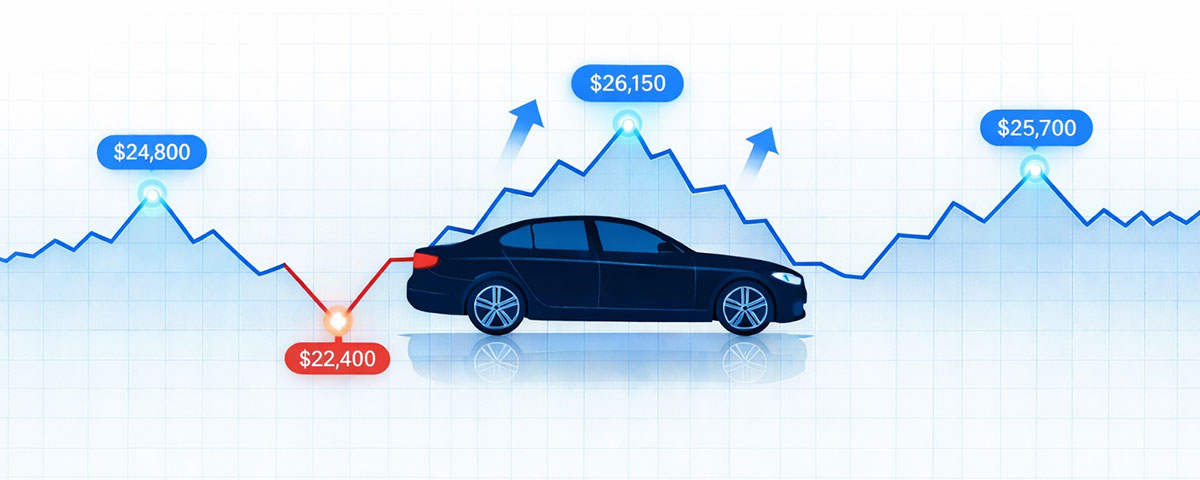
Most people assume used car prices change slowly…
Maybe month to month. Maybe year to year. Maybe only when something major happens.
And in some cases this is true…
But in many cases, used vehicle pricing moves far more frequently than most buyers and sellers realize. Not always dramatically. Not always visibly. But continuously.
That’s because used car markets are not updated on a schedule. They respond to behavior—inventory levels, buyer demand, manufacturer production, financing conditions, and competitive pricing—all of which shift in real time.
Understanding that dynamic helps explain why valuations can feel different from one week to the next, even when nothing about the vehicle itself has changed.
Inventory Levels Change Constantly
Inventory is the foundation of pricing pressure.
Dealer lots don’t sit static. Vehicles are acquired, sold, traded, wholesaled, and repriced every day. Auction supply fluctuates weekly. Lease return waves hit in clusters. Trade-in volumes rise and fall depending on broader market conditions.
When similar vehicles accumulate in a region, competition increases. Dealers adjust pricing to maintain inventory velocity. When supply tightens—whether due to strong demand or limited new inventory—pricing firms.
These shifts don’t happen neatly at month-end. They happen whenever inventory flows change.
A single high-volume auction week can increase supply in a segment. A spike in trade-ins can create short-term pricing pressure. A shortage of certain configurations can tighten available listings quickly.
Because inventory moves continuously, pricing reacts continuously.
Manufacturer Production and Supply Chain Effects
Used vehicle pricing doesn’t exist in isolation from new vehicle production.
When manufacturers experience supply constraints, the ripple effects reach the used market quickly. During the 2021–2022 supply chain disruptions, production slowdowns limited new vehicle availability. That shortage pushed more buyers into the used market, increasing demand and driving prices upward across many segments.
Some manufacturers adjusted pricing aggressively during that period. Tesla, for example, raised prices significantly on certain models as production capacity struggled to meet demand. When supply later stabilized and production caught up, prices were reduced sharply. Those adjustments affected both new and used markets—and some owners saw dramatic swings in vehicle value within relatively short windows. Some people got absolutely wrecked on Model S/X Plaid values, and even Model Y in some cases.
The broader lesson isn’t about one brand though—it’s about how quickly supply dynamics can shift.
When production increases, lease returns rise, or manufacturer incentives change, the used market responds. When production tightens or incentives disappear (including tax credits for EVs), pricing pressure moves in the opposite direction.
These forces do not operate on a quarterly schedule. They respond to logistics, factory output, shipping timelines, and policy decisions—all of which can shift rapidly.
Demand Is Not Static
On the demand side, buyer behavior also changes more frequently than people expect.
Interest rates influence affordability. Even small rate changes can shift monthly payment calculations enough to affect buyer decisions. Fuel prices influence segment preference. When gas prices rise, demand may shift toward smaller vehicles. When fuel costs stabilize, larger vehicles often regain strength.
Seasonality plays a role as well. Trucks and SUVs may strengthen during certain periods. Convertibles and specialty vehicles move differently depending on climate and time of year.
But demand shifts are not limited to seasons. Incentive programs, financing promotions, and regional economic factors all influence buyer activity.
When demand increases in a segment, dealers adjust prices upward or hold firm. When buyer interest cools, price reductions follow to maintain turnover.
These changes can occur within days or weeks.
Listings Adjust in Real Time
Unlike aggregated reports or published benchmarks, live listings react immediately to competitive pressure.
If one dealer lowers the price on a comparable vehicle, nearby listings often follow. If inventory ages past a certain threshold, sellers may reduce asking prices to avoid extended holding periods. If demand spikes for a specific configuration, prices may rise quickly.
Digital marketplaces have accelerated this responsiveness. Dealers and private sellers can see competing listings instantly and adjust accordingly. Pricing is no longer static once posted—it’s fluid (and this has been the case for a while now).
This real-time adjustment behavior means the visible market can shift well before those movements appear in compiled averages.
Asking prices change. Promotions change. Positioning changes.
The market doesn’t wait for formal reporting cycles.
Segment Volatility Varies
Not all vehicles move at the same pace.
High-demand, high-volume segments may experience tighter spreads and steadier pricing. Niche or specialty vehicles may swing more dramatically due to thinner inventory and more concentrated buyer pools.
Electric vehicles, for example, can react strongly to changes in manufacturer pricing, tax credits, or charging infrastructure developments. Trucks may respond more directly to fuel price swings or regional demand patterns. Entry-level vehicles often behave differently than luxury vehicles during shifts in financing conditions.
Because segments respond to different forces, volatility isn’t uniform.
Some vehicles experience subtle weekly adjustments. Others can reprice meaningfully within short windows when underlying conditions shift.
Liquidity and Urgency Create Micro-Movements
Even within the same segment, individual seller behavior contributes to price movement.
A dealer with aging inventory may reduce price more aggressively than a dealer with fresh stock. A private seller who needs to sell quickly may price below competing listings. A buyer facing financing deadlines may stretch to secure a vehicle immediately.
These micro-decisions accumulate across the market.
Each individual adjustment might be small. Together, they create ongoing movement.
That’s why two vehicles that appear similar can transact at slightly different prices within the same week. It’s not chaos. It’s liquidity interacting with urgency.
Why Movement Isn’t Always Obvious
If prices move frequently, why doesn’t it always feel that way?
Because averages smooth behavior.
Aggregated data tends to compress volatility into broader trends. Month-over-month charts may look gradual. Quarterly reports may show moderate movement.
But within those averages, individual listings may have adjusted multiple times. Segments may have strengthened or softened unevenly. Regional variations may have widened or narrowed.
The difference between live behavior and summarized averages can create the impression of stability even when underlying prices are shifting continuously.
Movement doesn’t always announce itself dramatically. Sometimes it’s incremental—small adjustments compounding over time.
Markets Are Continuous Systems
The broader point is simple: used car markets operate continuously.
Inventory flows in and out. Buyers enter and exit. Manufacturers adjust production. Incentives appear and disappear. Financing conditions evolve. Sellers reprice.
There is no universal “update moment.”
Pricing shifts whenever supply and demand shift—which can happen more often than many people assume.
That doesn’t mean volatility is constant or extreme. It means responsiveness is built into the system.
Recognizing that responsiveness helps explain why a vehicle’s positioning can change within weeks, or even days, without anything physically changing about the vehicle itself.
Generate a SynthAuto Valuation Report Today
If you want to see how a vehicle is positioned in today’s market, generate a SynthAuto valuation report in minutes.
Enter your VIN and a few quick details to receive an AI-powered valuation built on live market data and statistical modeling. Instead of relying solely on static benchmarks, you’ll see dynamic value ranges that reflect current market behavior—along with built-in confidence indicators.
It’s fast, and completely free!
Get your SynthAuto valuation report today.