
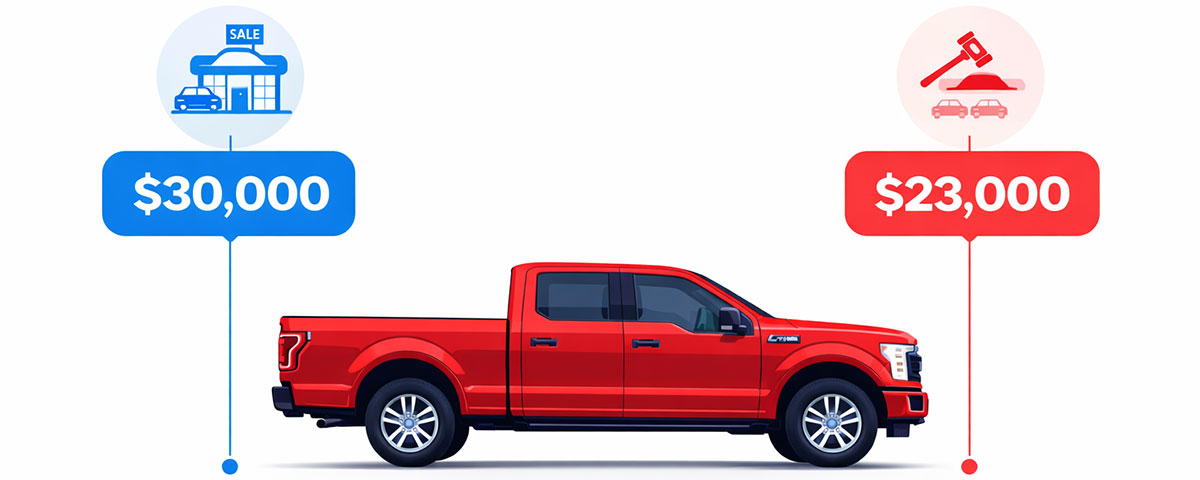
If you’ve ever compared a dealer’s retail listing price to a trade-in, wholesale, or cash offer, the gap can feel dramatic.
A vehicle listed for $28,000 might receive a $24,000 trade offer (or even less). A similar car advertised at retail may sit thousands above auction results.
The immediate reaction is often frustration: “Where is that money going?”
The answer isn’t hidden. It’s structural.
Retail and wholesale pricing exist in two different economic environments. The spread between them reflects cost, risk, time, and liquidity—not just profit.
Understanding that structure makes the gap easier to interpret.
Two Markets, Two Roles
Retail pricing represents the amount a dealer asks from a final consumer. And that involves a fair bit of stuff (sometimes) on the dealer’s end. Often a vehicle needs to be:
- Inspected
- Reconditioned
- Cleaned and photographed
- Marketed
- Displayed on a lot or platform
- Backed by some form of limited assurance
Wholesale pricing represents the acquisition side of the equation. It’s the price a dealer might pay at auction, or offer on trade, before that vehicle is prepared and marketed for retail sale.
These two numbers exist at different points in the vehicle’s lifecycle.
One reflects the cost to acquire the asset.
The other reflects the cost to sell it to an end buyer.
The spread between them exists because those are not the same function.
Reconditioning and Preparation
Retail vehicles are rarely sold exactly as acquired. They often go through “recon” (dealer speak).
Even well-maintained vehicles often require:
- Mechanical inspection
- Minor service
- Cosmetic touch-ups
- Detailing
- Compliance checks
Some vehicles require more significant reconditioning. Others require almost none. But the dealer pricing the car for retail often does not know with certainty what will emerge during inspection until after acquisition. Some dealer auctions provide a ton of information to the purchasing dealer, where others provide surprisingly little information—and wholesale pricing reflects that uncertainty.
A dealer making an offer must account for the possibility of:
- Unexpected mechanical issues
- Cosmetic flaws
- Tires or brakes near replacement
- Minor accident repairs
Retail pricing includes the cost of resolving those items. Wholesale pricing includes the risk of discovering them.
That risk is not theoretical. It’s operational.
Overhead Is Real
Retail pricing also reflects operating costs, and dealers (whether people like to believe this or not) can have substantial operational costs in certain areas; we’re not talking about a SaaS company here with a handful of API costs and no staff.
A dealership often carries expenses that do not exist in private-party transactions such as
- Facilities
- Staff
- Marketing
- Insurance/bonds/licensing fees
- Technology
- Financing systems
- Administrative costs
Those costs don’t attach to a single car in a neat, itemized way. They’re recovered across the inventory the dealership sells over time.
That same dealer who lists a vehicle at retail may also act as a wholesale buyer when acquiring inventory from auctions or private sellers.
When purchasing at auction or offering a trade-in value, that dealer is not only operating as a retailer, they’re acting as an acquirer of risk. At that stage, they must price conservatively enough to:
- Cover expected reconditioning
- Absorb operating overhead
- Protect against time and market risk
- Leave room for a viable retail margin
The wholesale price reflects what the vehicle is worth to the dealer before those downstream costs and risks are absorbed.
The retail price reflects what the vehicle must sell for after those costs and risks are accounted for.
The spread between the two is not about two different opinions of value. It reflects two different positions in the transaction chain.
That difference in structure creates a natural gap.
Time and Inventory Risk
Time is a cost.
When a dealer acquires a vehicle, capital is tied up until the car sells. During that time:
- Market prices may decline (for example, when Tesla massively cut prices in 2022)
- Demand may soften
- Competing inventory may increase
- Incentives may shift buyer attention
Even in stable markets, holding inventory introduces exposure.
Wholesale offers (including trade in and cash offer prices) attempt to account for that risk. Retail prices assume the vehicle will eventually sell at or near asking.
The longer a vehicle sits, the more pressure builds. Dealers may reduce price over time to maintain inventory velocity. That dynamic is built into acquisition math from the start.
The spread is partially a hedge against time (which is unpredictable).
There are dealers who literally went out of business thinking they could flip Teslas in 2022, because they acquired vehicle at a high cost from various channels (auctions, private parties), and when the supply chain caught up and Tesla was able to cut pricing back to a more normal level, many dealers (and private parties too) were left massively upside down. Think $20k+ upside down in some cases on Model S/X Plaids as an example.
Liquidity and Convenience
A trade-in or wholesale sale offers something retail does not: speed and certainty.
If a private seller accepts a trade-in offer:
- The transaction can happen immediately.
- There’s no advertising.
- No test drives.
- No negotiation with multiple buyers.
- No uncertainty about payment.
That convenience has economic value; people pay (to some degree) for the convenience, and dealers charge for that (well, it’s built into the cost).
They are taking risk though, as retail sales typically involve:
- Time on market
- Price negotiations
- Potential financing contingencies
- Buyer inspection requests
This should help to illustrate the differences between a private party sale price, trade-in, wholesale, retail, etc. Risk and time are big factors.
Not All Spreads Are Equal
The gap between wholesale and retail is not fixed.
It varies by:
- Vehicle segment
- Price range
- Demand strength
- Inventory depth
- Market volatility
A high-demand vehicle with tight supply may trade closer to retail. A slower-moving vehicle in a saturated segment may show a wider spread.
Lower-priced vehicles sometimes show proportionally larger spreads because fixed operating costs represent a higher percentage of the total price.
Luxury vehicles may show larger absolute spreads but tighter percentage spreads.
Spread Is Not Pure Profit
One common misconception is that the entire difference between wholesale and retail equals dealer profit, and it does not.
As has been explained throughout this article, from the spread a dealer must absorb:
- Reconditioning costs
- Operating expenses
- Marketing
- Financing costs
- Sales commissions
- Warranty exposure
- Market risk
What remains after those items is gross profit. From that, broader business costs are covered.
Some transactions generate strong margins. Others compress quickly due to competition or pricing pressure.
In tight markets, spreads often narrow. In uncertain markets, spreads may widen to compensate for increased risk.
Profit exists—but it exists within a structure of cost and exposure.
Retail Listings Aren’t Always Final Prices
Another nuance often overlooked: retail listing prices are not always final transaction prices.
The advertised price is an ask (sometimes this is still true, even at “no negotiation” dealerships) . Final sale price may fall within a negotiation band.
Similarly, a wholesale offer may move slightly depending on condition verification, and both sides operate within ranges.
This is why thinking about value as a single fixed number can oversimplify what is actually a band shaped by negotiation and timing.
Market Conditions Change the Math
When inventory tightens and demand rises, spreads tend to compress. Dealers may compete more aggressively for inventory, raising trade-in values and reducing the gap between acquisition and retail.
When inventory builds and demand softens, spreads often widen. Dealers must protect against longer holding times and potential price declines.
The spread is not static—it adjusts to liquidity conditions.
In volatile markets, uncertainty alone can increase risk premiums embedded in wholesale pricing.
In stable markets with predictable turnover, acquisition math becomes more aggressive.
Understanding this dynamic helps explain why trade-in values may feel stronger in some periods and weaker in others—even if the vehicle itself hasn’t changed.
Different Channels, Different Outcomes
Private-party sales sit somewhere between wholesale and retail.
A private seller does not absorb dealership overhead. But they also do not offer the same assurances or financing structures.
As a result, private sale prices often fall between wholesale and retail benchmarks.
Where a transaction lands depends on:
- Seller urgency
- Buyer demand
- Market competition
- Condition verification
- Negotiation skill
No single channel defines “true value.” Each reflects a different mix of cost, risk, and convenience. And as mentioned in the Tesla example above, the private market can change fast too, depending upon actions by the manufacturer and other various factors.
The Broader Takeaway
The spread between wholesale and retail pricing is not arbitrary. It reflects structural differences between acquiring inventory and selling to end consumers.
To reiterate, it often accounts for:
- Reconditioning
- Operating costs
- Capital exposure
- Time risk
- Market volatility
- Liquidity preferences
Understanding these mechanics helps set realistic expectations.
If sellers want maximum potential price, they may assume more time and uncertainty.
If sellers want speed and certainty, they may accept a liquidity discount.
Neither path is inherently better, they just represent different tradeoffs.
Recognizing that retail and wholesale operate in different economic environments makes the spread easier to interpret—and less mysterious.
Generate a SynthAuto Valuation Report Today
If you want information on how a vehicle may be positioned across different market channels, you can generate a SynthAuto valuation report in minutes.
Enter your VIN and a few quick details to receive an AI-powered valuation built on live market data and statistical modeling. You’ll see structured pricing ranges that reflect retail positioning, wholesale/trade-in dynamics, and real-world market behavior—along with built-in confidence indicators.
It’s fast, easy, and best of all—completely free.
Get your SynthAuto valuation report today!