
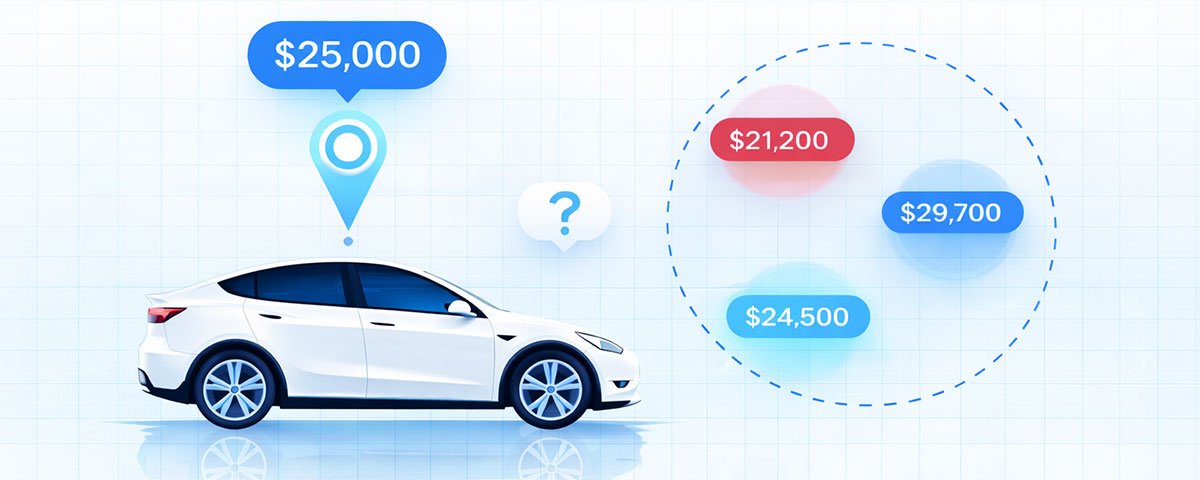
If you’ve ever checked your car’s value online, you’ve probably been given a single number.
$18,742.
$26,100.
$14,500.
It feels precise. It feels authoritative. It feels actionable.
A single number is clean. It’s easy to compare. It gives the impression that the market has spoken.
The problem is that vehicle markets don’t actually behave that way.
A car’s value is rarely a fixed point. It’s a range shaped by liquidity, demand, timing, condition, and more. When valuation tools compress that range into a single number without context, it can be less comprehensive than ranges.
This isn’t about attacking single-number valuations. In some situations, they can be useful reference points. But without understanding what sits behind that number, it’s easy to mistake precision for accuracy—and those are not the same thing.
Markets Don’t Clear at a Single Price
When people think about value, they often imagine something like a stock price: one clear number that reflects supply and demand at that moment.
Used vehicles don’t work like that.
Even in active markets, similar vehicles can transact across a meaningful spread. Two nearly identical cars may sell thousands of dollars apart depending on:
- The urgency of the seller
- The aggressiveness of the buyer
- Local inventory conditions
- Time of month or quarter
- Minor condition differences
- Negotiation dynamics
Retail listing prices alone show variability. One dealer may list aggressively to move inventory quickly. Another may hold out for higher margins. Private sellers operate under entirely different incentives.
The result is not a single clearing price. It’s a band of plausible outcomes.
That band may be tight in a stable market with deep inventory. It may widen in volatile or thin markets. But it exists either way.
When a valuation tool collapses that variability into a single point, it can obscure the reality that value is situational.
The Illusion of Precision
There’s something psychologically powerful about a number with no decimals or qualifiers.
$21,386 feels more credible than “$20,000–$22,500.”
But that added precision often reflects formatting, not certainty.
Imagine two valuation approaches:
- A tool says your car is worth $18,742.
- Another says the likely retail range is $17,800–$19,200.
The first feels more exact. The second feels less decisive.
Yet the second may actually be more honest about the underlying data.
Precision implies exactness. Accuracy reflects closeness to reality. You can present a very precise number that sits in the middle of a wide, uncertain distribution. The precision does not make it more correct.
In markets with variability, presenting a single point without context can unintentionally imply that the real-world transaction price should land right there. In practice, transaction prices float within a spread shaped by conditions that shift daily.
What Actually Drives Variability in Used Car Values
To understand why ranges matter, it helps to look at what drives dispersion in the first place.
Mileage is an obvious factor, but even mileage effects aren’t linear. Some segments are more sensitive than others. A high-mileage economy sedan may be penalized differently than a high-mileage specialty vehicle.
Condition plays a role, but “condition” itself is subjective. Two sellers may describe vehicles similarly while buyers perceive them differently once inspected.
Regional demand introduces another layer. A truck may command a premium in one state and a discount in another. Inventory depth amplifies this: when similar vehicles are scarce, pricing power shifts. When listings flood the market, buyers gain leverage.
Timing also matters. Seasonal shifts affect certain segments more than others. Broader economic factors—interest rates, fuel prices, consumer confidence—filter into vehicle demand unevenly.
Then there’s liquidity. A vehicle that attracts strong buyer interest may transact quickly near the top of its range. A vehicle in a slower-moving segment may require pricing concessions to move.
All of these forces create dispersion. A single number cannot fully capture that dispersion without simplifying away meaningful context.
Retail, Wholesale, and the Spread Problem
Another reason single-point values can mislead is that they often blur different market channels.
Retail pricing behavior is not the same as wholesale behavior. Dealer acquisition costs differ from private party expectations. Trade-in offers reflect convenience and risk adjustments.
When someone searches “What is my car worth?”, they may be thinking of:
- What a dealer would list it for
- What a dealer would pay at auction
- What a private buyer might pay
- What they might receive on trade
- What a cash offer platform might quote
Those are not identical numbers. They exist along a structured spread.
If a valuation tool presents a single number without clarifying which channel it represents—or how it relates to others—it can blur meaningful distinctions.
In practice, professional buyers think in ranges and spreads. They understand that acquisition price, retail ask, and negotiated sale price are related but distinct.
A single-point estimate that doesn’t specify context can collapse those layers into one simplified anchor.
Market Stability Changes the Shape of the Range
Not all markets are equally volatile.
In stable periods with strong data density—many comparable listings, consistent days-on-market patterns, predictable inventory turnover—the likely transaction band may be narrow. In those cases, a single midpoint may sit comfortably within a tight distribution.
In more volatile conditions, the band widens (which is true for specialty vehicles or new vehicles; think about when the Cybertruck first dropped, what people were paying to get their hands on one).
Inventory shocks, sudden shifts in demand, incentive changes, or macroeconomic events can stretch the dispersion between high and low outcomes. Data becomes noisier. Signals conflict. Confidence weakens.
The key insight is that variability itself varies.
A static single number does not communicate whether the surrounding distribution is tight or wide. A value that sits inside a $500 band carries a different level of implied certainty than one inside a $2,500 band.
Without visibility into that surrounding structure, it’s easy to misinterpret how much confidence a number deserves.
When Single Numbers Are Useful
It’s important not to overcorrect.
Single-point values can serve a purpose. They can function as:
- Anchors for discussion
- Midpoints within a broader range
- Simplified references in stable markets
- Starting points for negotiation
The issue isn’t the existence of a number. It’s the absence of context.
A single-point estimate accompanied by an understanding of market spread, confidence level, and channel positioning can be helpful. A single-point estimate presented as definitive can overstate certainty.
The difference lies in whether the number is framed as a precise prediction or as a statistical anchor within a broader distribution.
Professional Buyers Don’t Think in Dots
In wholesale environments and dealership acquisition desks, pricing rarely revolves around a single exact figure. Buyers typically think in terms of thresholds and acceptable bands.
They assess:
- Downside risk
- Expected reconditioning cost
- Time-to-turn
- Target margin
- Market depth
The resulting internal valuation often has a ceiling and a floor. The offer may land at a specific number, but that number exists within a broader tolerance range shaped by risk.
This band-based thinking mirrors how markets actually clear.
Even in retail settings, dealers may list at one price but expect negotiation within a predictable window. Private sellers may start high and settle lower. Buyers may anchor low and move upward.
The eventual transaction sits somewhere within that negotiated band.
Understanding value as a distribution better reflects that reality than treating it as a fixed dot.
The Role of Confidence
One of the most overlooked elements in vehicle valuation is confidence.
Confidence is influenced by:
- The number of comparable vehicles available
- The recency of market data
- Agreement between pricing signals
- Inventory volatility
In dense, stable markets, confidence can be high. In thin or shifting markets, confidence drops.
A single-point value rarely communicates how strong or weak the underlying signal is. Two vehicles might both be assigned a value of $22,000, yet one estimate could be backed by deep, consistent comparables while the other relies on sparse or conflicting data.
Without some acknowledgment of uncertainty, it’s difficult to gauge how much weight to place on the number.
Ranges and confidence indicators don’t eliminate ambiguity, but they acknowledge it. They signal that pricing is probabilistic, not absolute.
Value Is Contextual, Not Fixed
Ultimately, vehicle pricing is shaped by context.
A seller prioritizing speed may accept the lower end of a range. A seller willing to wait may test the upper bound. A dealer balancing inventory risk may price conservatively. A buyer chasing a specific configuration may stretch higher.
None of those outcomes invalidate the concept of value. They illustrate that value is not static.
When valuation tools compress that context into a single number without explaining the surrounding band or variability, users may overestimate how tightly reality will adhere to that figure.
A more nuanced approach recognizes that value lives inside a structured range influenced by liquidity, timing, and market behavior.
Aligning Valuation with Market Reality
The goal isn’t to eliminate clarity. It’s to align pricing with how markets actually function.
Used vehicle markets are dynamic systems. They operate within spreads. They respond to supply and demand shifts. They generate distributions of plausible outcomes rather than single immutable truths.
Single-point values can be useful anchors, especially in stable conditions. But without context around variability and confidence, they risk implying more certainty than the market can reliably provide.
Recognizing that value is a range—not just a number—better reflects how vehicles are actually bought and sold.
And that perspective leads to more informed decisions, whether you’re listing, trading, or simply trying to understand where your vehicle sits in today’s market.
Generate a SynthAuto Valuation Report
Plugin your VIN and a few other quick details into SynthAuto and get a valution report today—and best of all, it’s totally free!